Share this
by HEPACART on Jun 15, 2026
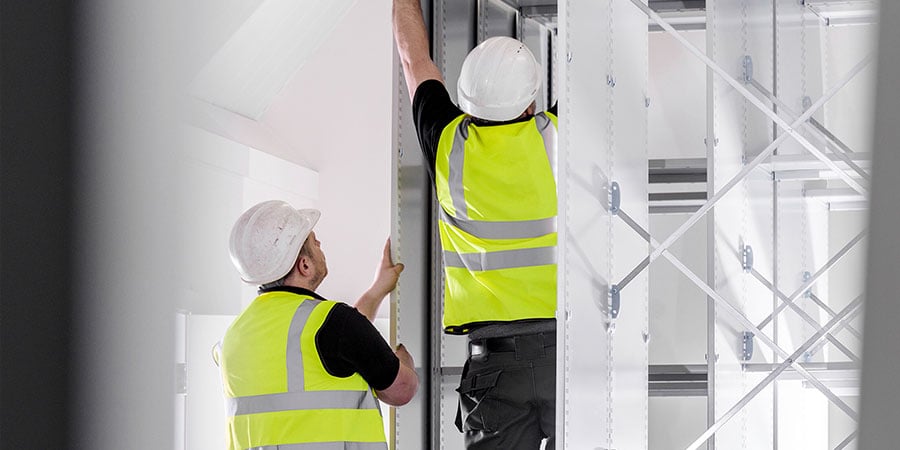
Healthcare construction does not leave much room for “good enough” containment.
In a standard construction environment, dust is often treated as a cleanup issue. In an active healthcare facility, dust migration can become an infection-control concern, a project delay, an inspection issue, and a budget problem at the same time.
That is why construction dust control matters far beyond the work zone. When containment fails or requires constant correction, the cost rarely appears as one clean line item. It shows up in added labor, repeated setup, rework, downtime, coordination meetings, Infection Prevention review, delayed phases, and uncomfortable conversations with leadership.
The Joint Commission requires hospitals to conduct a preconstruction risk assessment for demolition, construction, or renovation work, including risks related to air quality, infection control, utilities, noise, vibration, and other hazards that may affect patients, staff, visitors, or assets. CDC guidance also warns that construction activity can disperse fungal spores and calls for education and control methods to reduce airborne infection risks during healthcare construction.
The financial point is straightforward: poor containment costs more than the materials used to build it.
Why Poor Containment Gets Expensive Fast
Poor containment does not always fail dramatically. Most of the time, it creates smaller problems that compound throughout the project.
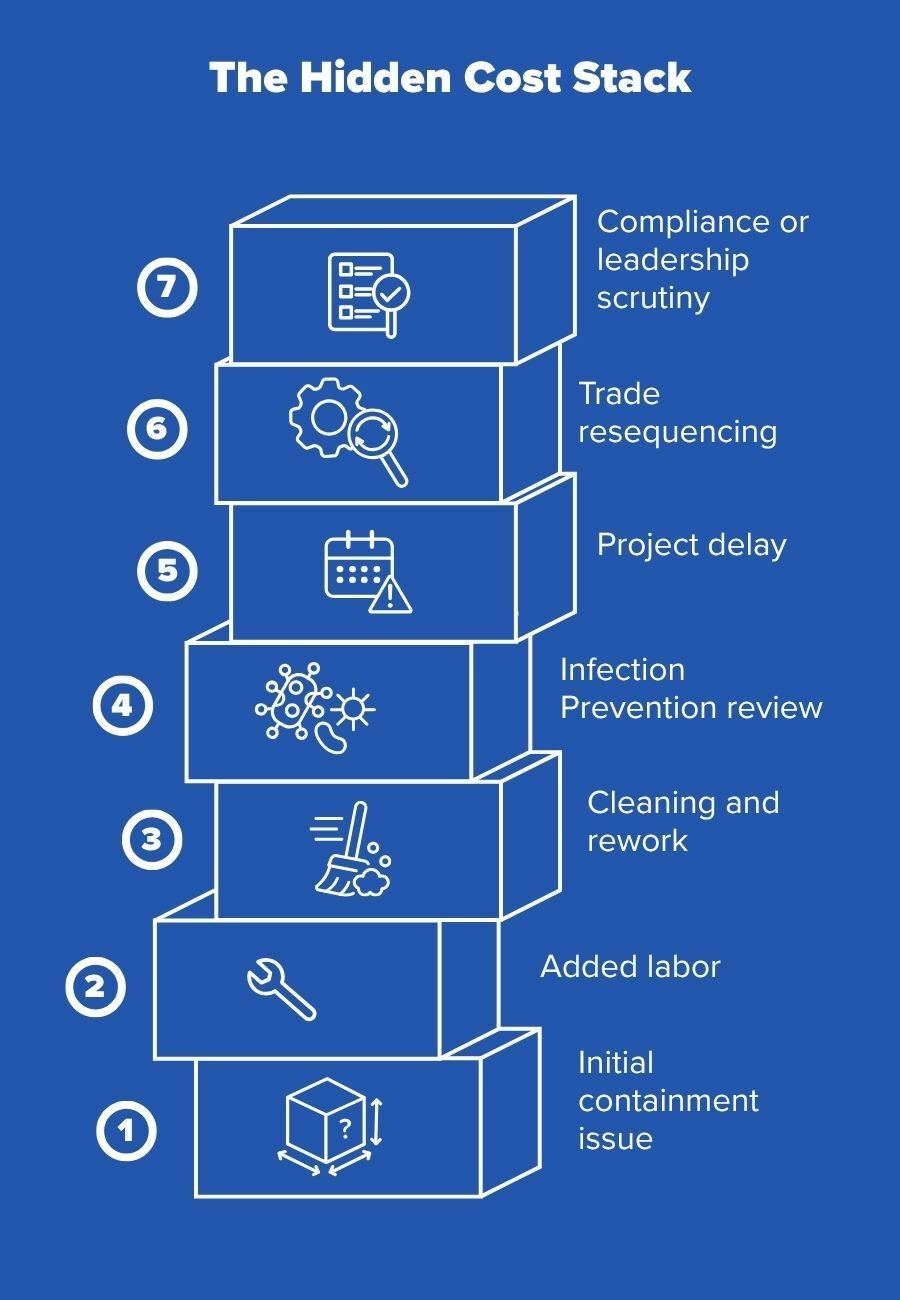
A temporary barrier needs to be adjusted. A negative pressure setup does not hold consistently. Dust is found outside the work area. A nearby department raises concerns. Infection Prevention asks for verification. A crew has to pause while the issue gets corrected. A phase slips by half a day, then another trade gets pushed, then the schedule starts to move.
None of those moments may look catastrophic on their own. Together, they create real cost.
For healthcare construction teams, construction dust containment is not just about keeping an area clean. It is about maintaining a controlled environment while work happens around patients, staff, visitors, and active clinical operations. That means the cost of containment has to be evaluated against the cost of failure, not just the cost of the equipment or materials used at the start of the job.
The Main Cost Categories of Poor Construction Dust Control
Good containment may look like a project expense. Poor containment becomes an operational expense.
Cost 1: Rework When Containment Has to Be Corrected
Rework is one of the most visible costs of poor containment.
If a containment setup does not hold, the team may need to stop work, rebuild the barrier, reseal openings, adjust airflow, reclean affected areas, or repeat parts of the setup process. In healthcare construction, this is not just inconvenient. It can affect access, sequencing, Infection Prevention approval, and staff confidence.
Common rework triggers include:
- Gaps in temporary containment barriers
- Dust migration into adjacent spaces
- Negative pressure loss
- HEPA filtration equipment that is undersized or poorly placed
- Doors, zippers, or access points that do not stay sealed during active work
- Above-ceiling work that releases dust outside the intended work zone
- Containment setups that crews bypass because they are too slow or awkward to use
This is where “cheap” containment becomes expensive. If the initial setup saves money but requires repeated correction, the project pays for that decision through labor, time, and oversight.
Cost 2: Delays That Ripple Beyond the Work Area
Project delays are not always caused by major failures. Sometimes they are caused by uncertainty.
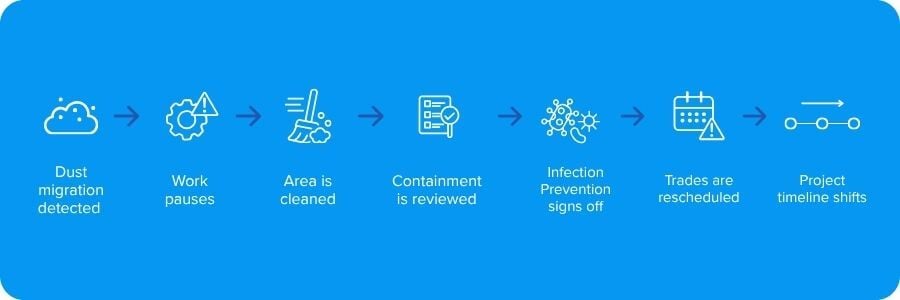
If Infection Prevention, facilities, or safety leaders are not confident in the containment setup, work may slow until the issue is reviewed. If dust is found where it should not be, crews may need to pause while the affected area is cleaned and the source is identified. If air control cannot be verified, the team may need to troubleshoot before the next phase begins.
In healthcare construction projects, one delay can quickly affect:
- Trade sequencing
- Department access
- Patient flow
- Inspection timing
- Utility shutdown windows
- After-hours or weekend work plans
- Contractor availability
- Project manager credibility
A half-day delay can become more expensive when it forces resequencing or pushes another trade into overtime. That is why healthcare construction dust control should be viewed as a schedule protection tool, not just an infection-control requirement.
Cost 3: Added Oversight From Facilities and Infection Prevention
Poor containment increases the number of people required to keep the project moving.
Instead of the work progressing under a clear plan, facilities leaders, Infection Prevention, safety teams, project managers, and contractors may all need to spend more time coordinating. That oversight may include walkthroughs, air pressure checks, documentation reviews, containment adjustments, cleaning verification, and stakeholder updates.
The more manual the containment process is, the more the project depends on people catching problems before they spread.
That creates cost in two ways. First, it consumes time from people who are already stretched thin. Second, it increases the risk that something gets missed because the process depends too heavily on individual vigilance.
Strong construction dust control reduces that burden by making containment more consistent, repeatable, and easier to verify.
Cost 4: Compliance Risk and Inspection Pressure
Healthcare construction is evaluated differently than standard commercial work because the environment is tied to patient safety.
The CDC recommends educating both construction teams and healthcare staff in immunocompromised patient-care areas about airborne infection risks related to construction activity and methods to control fungal spore dissemination. ASHE also provides ICRA 2.0 tools for construction, renovation, and operations, including a matrix of precautions and an Infection Control Risk Assessment and permit.
That means containment decisions should be defensible. If a setup is questioned, the team needs to show that controls were planned, implemented, monitored, and corrected when needed.
Poor containment can create compliance pressure through:
- Inconsistent application of ICRA precautions
- Lack of documentation for containment and airflow controls
- Unclear responsibility between contractors, facilities, and Infection Prevention
- Repeated field adjustments that are not reflected in the plan
- Inability to explain how airborne contaminants are being controlled
- Conditions that do not match the approved infection-control plan
This is where cost becomes more than budget impact. Compliance issues can damage trust between teams and invite more scrutiny on future projects.
Cost 5: Cleaning and Environmental Services Burden
When containment fails, cleaning demand increases.
That may include additional terminal cleaning, dust removal, surface cleaning, filter changes, disposal steps, or repeated inspections before an area can return to normal use. The CDC recommends bagging dust-filled filters immediately after removal to prevent dispersion of dust and fungal spores during transport in the facility.
In active facilities, cleaning is not just a housekeeping task. It affects room availability, staff workload, patient movement, and department confidence.
Poor containment can also create confusion around who owns cleanup. Is it the contractor? Facilities? Environmental Services? The project team? Infection Prevention? When ownership is unclear, costs rise because multiple groups spend time resolving a problem that better containment could have prevented.
Cost 6: Worker Exposure and Safety Controls
Construction dust control also intersects with worker safety.
OSHA’s respirable crystalline silica standard for construction requires employers to limit worker exposure and use specified controls, work practices, and respiratory protection for covered tasks. OSHA’s silica guidance explains that employers can use control methods in Table 1 or measure exposure and independently determine which controls limit exposure to the permissible exposure limit.
Not every healthcare construction dust issue is a silica issue, but the larger principle still matters. Dust control is not optional field housekeeping. It is part of a broader safety and exposure-control strategy.
When dust controls are weak, teams may face additional requirements for respiratory protection, monitoring, work practice changes, or task modification. Those requirements can add cost, slow work, and increase coordination needs.
Cost 7: Loss of Trust From Infection Prevention and Facility Leadership
Trust has economic value on a healthcare construction project.
When a team consistently maintains containment, controls airflow, and keeps work areas clean, stakeholders are more likely to let the project proceed without excessive intervention. When issues repeat, every next step gets more scrutiny.
That scrutiny may be warranted, but it still costs time.
Once confidence drops, project teams may experience:
- More frequent inspections
- More documentation requests
- More meetings before phase transitions
- More resistance to proposed methods
- Slower approvals for similar work
- Greater leadership involvement in routine decisions
In other words, a containment issue on one phase can affect the pace of the next phase. Poor construction dust containment creates a reputation problem inside the facility, not just a field problem inside the work zone.
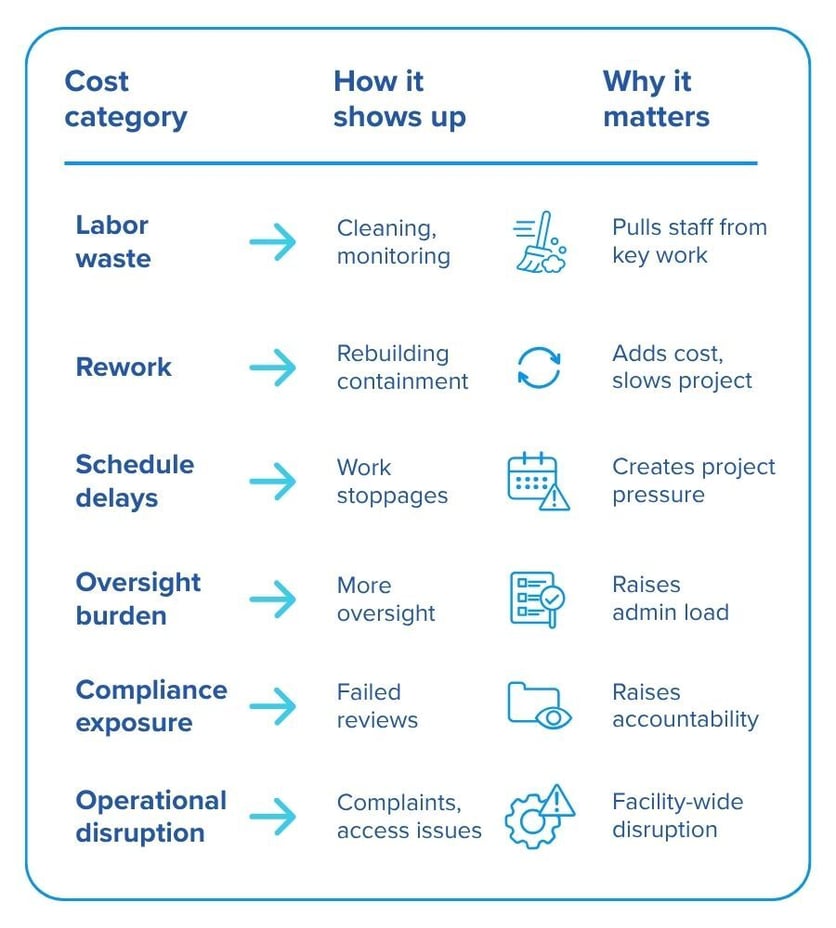
A Practical Cost Breakdown for Poor Containment
The true cost of poor containment is easiest to understand when each operational issue is tied to the financial consequence it creates.
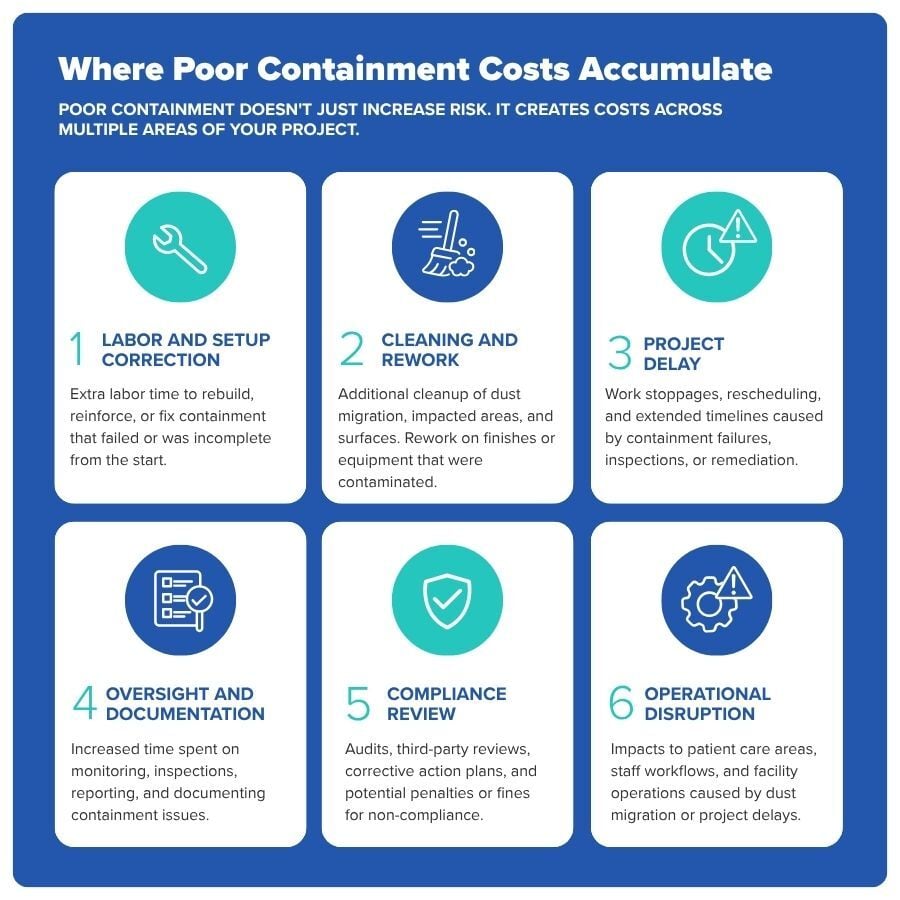
The pattern is clear. Poor containment does not stay isolated. It spreads cost across labor, schedule, oversight, compliance, and operational confidence.
What Strong Containment Should Reduce
A better containment strategy should not add complexity to an already difficult project. It should reduce the number of variables that teams have to manage manually.
Strong construction dust control should help teams:
- Set up containment quickly and consistently
- Maintain sealed separation between the work area and occupied spaces
- Support negative air and HEPA-filtered air management where required
- Reduce dust migration during demolition, renovation, above-ceiling work, and maintenance
- Minimize crew confusion and training burden
- Give Infection Prevention and facilities teams more confidence in the setup
- Reduce repeated correction, cleanup, and oversight
This is where products like HEPACART® mobile containment carts, HEPAFORCE® negative air machines, anteroom systems, ceiling access protection, and portable air purification can support healthcare construction teams. The value is not just the equipment itself. The value is a more repeatable system for managing risk, labor, and disruption.
For supporting education, use the internal anchor negative air machines for this blog link:
Comparing Low-Cost Containment vs. Cost-Control Containment
The lowest-cost containment option is not always the lowest-cost project option.
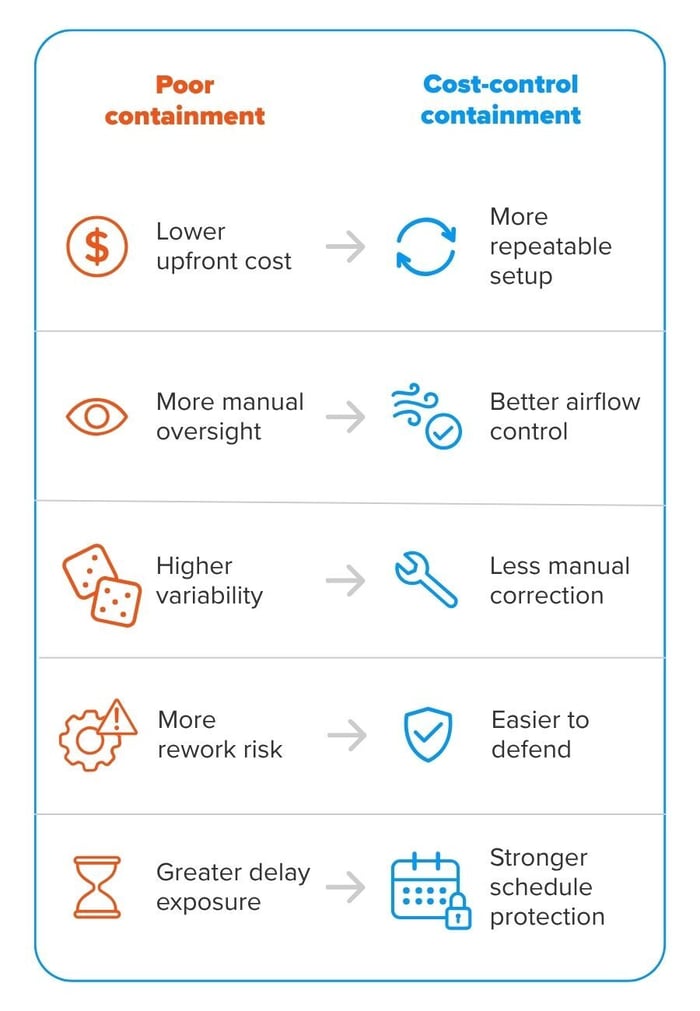 The better question is not, “What is the cheapest way to contain dust today?”
The better question is, “Which approach reduces total project cost, compliance risk, and operational disruption across the full job?”
How to Evaluate the Cost of Your Current Containment Process
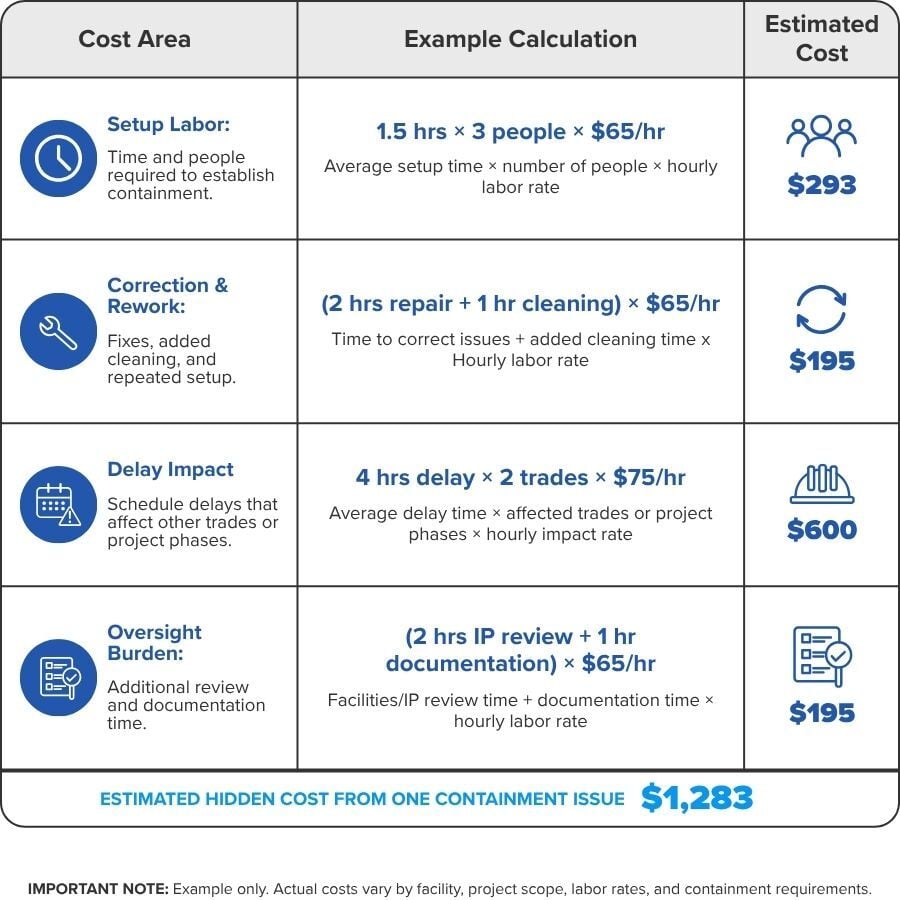
Most teams do not track the cost of poor containment directly. It gets buried inside labor, project delay, change orders, cleaning time, or general coordination.
A simple review can reveal whether containment is costing more than expected.
1. Track setup and teardown time
How long does it take to set up containment for routine work, above-ceiling access, renovation phases, or maintenance tasks?
If each setup requires multiple people, repeated adjustments, or custom field decisions, the labor cost may be higher than expected.
2. Count correction events
How often does containment need to be repaired, resealed, repositioned, or rebuilt?
Correction events are a strong signal that the current process is too variable.
3. Review delay causes
Look at recent healthcare construction projects and identify whether dust, access, airflow, cleaning, or infection-control review caused delays.
Even small delays can be meaningful when they affect trade sequencing or clinical operations.
4. Ask who is carrying the oversight burden
If facilities, Infection Prevention, or project managers are constantly checking the setup, the process may be consuming leadership time that is not being accounted for in the project budget.
5. Identify repeat-use opportunities
If the same type of work happens across multiple departments, campuses, or phases, reusable containment equipment may create stronger long-term value than rebuilding temporary setups each time.
Where HEPA Filtration Fits Into the Cost Conversation
HEPA filtration is often discussed as a technical feature, but in healthcare construction it has direct operational value.
HEPA-filtered air management can help control airborne particles when paired with proper containment design, negative air, sealed barriers, and project-specific infection-control planning. It should not be treated as a substitute for containment. It works as part of a broader system.
For projects involving construction dust, airborne contaminants, and active care environments, the goal is not simply to “clean the air.” The goal is to control where air moves, reduce particle migration, and support the requirements defined during the project’s risk assessment.
Common Questions About Construction Dust Control Costs
Why is construction dust control more expensive in healthcare environments?
Construction dust control is more expensive in healthcare environments because the work has to protect patients, staff, adjacent spaces, and active operations. The project may need containment, negative air, HEPA filtration, access control, documentation, monitoring, and coordination with Infection Prevention or facilities teams.
The cost is higher because the risk is higher.
Is poor containment usually a budget issue or a process issue?
It is usually both. Budget pressure may lead teams toward cheaper temporary methods, but the bigger issue is often process variability. If every crew sets up containment differently, the organization pays for inconsistency through oversight, correction, cleaning, and delays.
Can better containment reduce labor costs?
Yes, better containment can reduce labor costs when it shortens setup time, limits repeated adjustments, reduces cleanup, and lowers the need for constant oversight. The strongest savings usually appear across repeated projects, recurring maintenance, and phased renovations.
Does negative air replace physical containment?
No. Negative air does not replace physical containment. It supports air control within a properly contained work area. Healthcare construction teams still need sealed separation, controlled access, appropriate filtration, and project-specific infection-control planning.
What is the biggest hidden cost of poor containment?
The biggest hidden cost is often lost time. That includes field labor, project management time, Infection Prevention involvement, cleaning time, delayed trades, and leadership escalation. Those hours may not appear under “containment,” but they still affect the project budget.
Decision Guidance: When Poor Containment Is Already Costing You
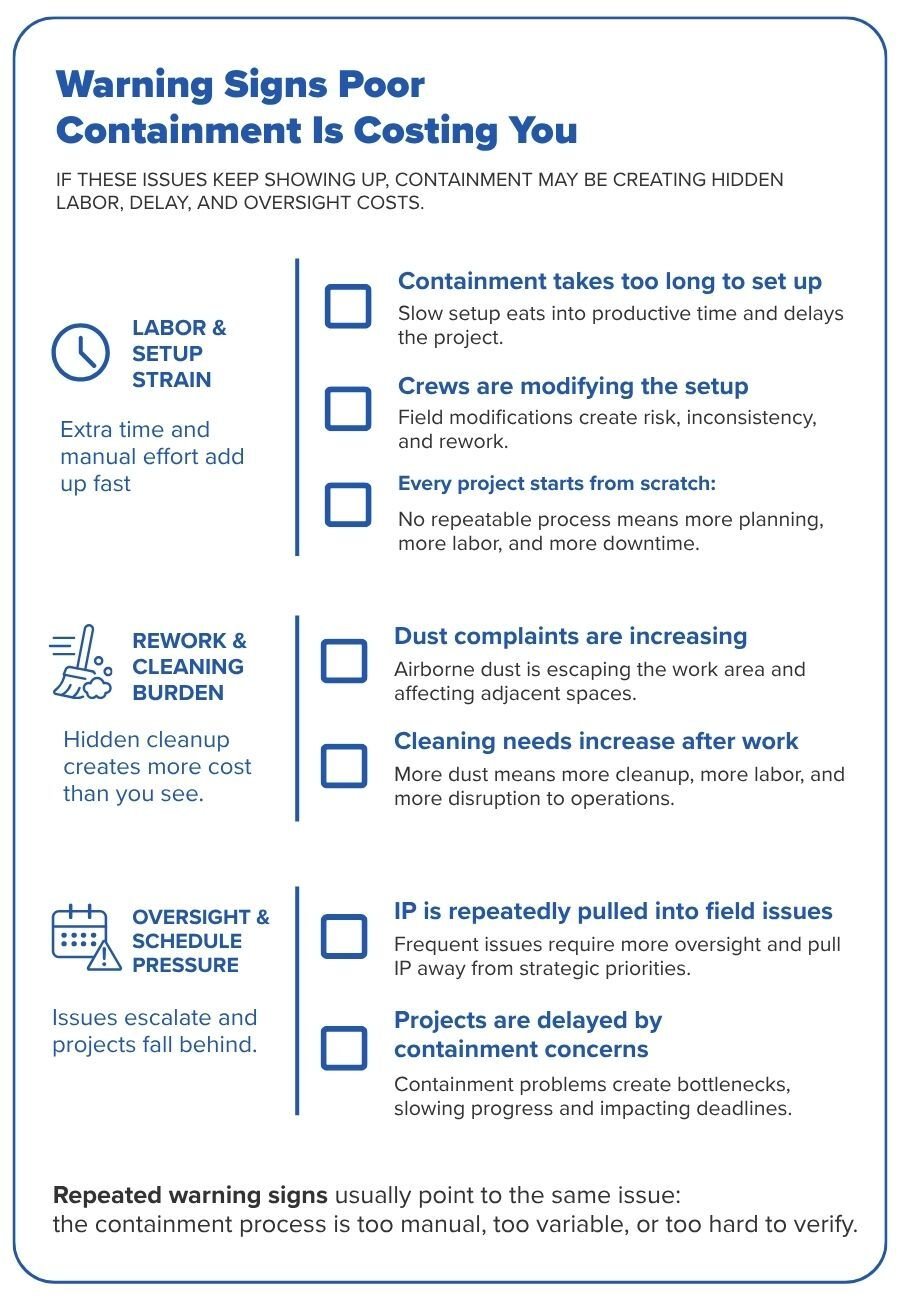
Poor containment is likely costing more than you think if your team is seeing any of these patterns:
- Containment takes too long to set up
- Crews frequently modify or bypass the setup
- Dust complaints are coming from nearby departments
- Infection Prevention is repeatedly pulled into field issues
- Negative air or filtration setups require frequent troubleshooting
- Cleaning needs increase after construction activity
- Projects are delayed by access, dust, or containment concerns
- Facilities teams are spending too much time coordinating temporary work
- Each project starts from scratch instead of using a repeatable containment process
When these patterns show up, the issue is not just the individual project. It is the lack of a dependable system for healthcare construction dust control.
Protect the Budget by Controlling the Work Zone
The true cost of poor containment is not limited to one failed barrier, one delayed phase, or one extra cleaning request.
It is the cumulative cost of uncertainty.
Healthcare construction teams are already balancing schedule pressure, patient safety, Infection Prevention expectations, facilities continuity, and budget control. A weak containment process adds another variable to a job that already has too many.
The right construction dust control strategy helps reduce that uncertainty. It gives crews a clearer setup. It gives facilities and Infection Prevention teams more confidence. It helps project leaders protect schedules and budgets without treating containment as an afterthought.
When containment is consistent, work moves with fewer interruptions. When dust and airflow are controlled, oversight becomes more manageable. When the system is repeatable, the cost of each project becomes easier to defend.
To evaluate tools that support infection control during healthcare construction, download HEPACART’s infection control resource.