
Share this
by HEPACART on Jun 01, 2026
Ambulatory Surgery Centers do not have much room for operational friction.
Every scheduled case depends on room availability, staff coordination, sterile conditions, physician schedules, patient readiness, and equipment reliability. When one piece of that system slows down, the impact rarely stays isolated. Delayed turnovers can push back procedures. Construction or maintenance work can create extra coordination. Infection control concerns can force teams to pause, reassess, or reschedule.
So when someone recommends adding another piece of equipment, especially portable HEPA filtration, the first question is fair:
Will this slow down my OR?
The honest answer is: it depends on the system.
The right portable HEPA filtration equipment can support active clinical spaces by helping control airborne contaminants, supplement air cleaning, and reduce disruption during construction, renovation, maintenance, or phased facility upgrades. The wrong equipment can create exactly what ASC leaders are trying to avoid: slow setup, staff confusion, extra oversight, poor placement, airflow problems, and one more variable in an already tight schedule.
For ASCs, the goal is not simply to add air filtration. The goal is to choose a system that supports infection control without creating new delays.
Why OR Throughput Pressure Changes the Filtration Conversation
In a hospital, downtime is serious. In an ASC, downtime is often immediate revenue loss.
ASC operations are built around procedural volume and room utilization. A delayed OR can affect the entire day’s schedule. A canceled case can affect revenue, physician satisfaction, staff productivity, and patient experience. That changes how leaders evaluate infection control equipment.
A product may meet a technical need, but if it takes too long to place, requires complicated setup, blocks movement, or needs constant attention, it becomes an operational risk.
That is why portable HEPA filtration needs to be evaluated through two lenses at the same time:
- Clinical and infection control performance
- Operational impact on procedure schedules
The Joint Commission requires hospitals to complete a preconstruction risk assessment for demolition, construction, or renovation work, including risks related to air quality, infection control, utilities, noise, vibration, and other hazards that could affect patients, staff, visitors, or assets. CDC environmental infection control guidance also addresses the need for infection control measures during construction and renovation activities in healthcare facilities, including precautions to prevent dust and contaminants from entering patient-care areas.
For ASCs, those requirements are not theoretical. Construction dust, airflow disruption, above-ceiling work, maintenance activity, and renovation phases all have to be managed without compromising scheduled procedures.
The Real Objection: “We Don’t Have Time for Another Process”
When ASC leaders push back on portable air purification or portable HEPA filtration, the concern is not always about whether filtration matters.
The concern is usually more practical:
- Will this take too long to set up?
- Will my staff need training they do not have time for?
- Will this get in the way of room turnover?
- Will it create noise, clutter, or workflow disruption?
- Will Infection Prevention still need to inspect or adjust everything?
- Will this help us keep cases moving, or will it become one more bottleneck?
Those are valid concerns.
An ASC cannot afford equipment that only works in ideal conditions. It needs equipment that works in real clinical environments where hallways are tight, schedules are full, teams are lean, and construction or maintenance windows are limited.
That is where the difference between “adding equipment” and “standardizing a system” matters.
Portable HEPA Filtration Should Reduce Risk, Not Add Friction
Portable HEPA filtration is often discussed as an air-cleaning tool, but in an ASC setting, it is also an operational control.
A HEPA filter is a high-efficiency particulate air filter. The EPA states that HEPA filters can theoretically remove at least 99.97% of dust, pollen, mold, bacteria, and airborne particles at 0.3 microns. That matters because construction, renovation, and maintenance activity can disturb dust and particles that should not migrate into clinical spaces.
But filtration efficiency alone does not answer the throughput question.
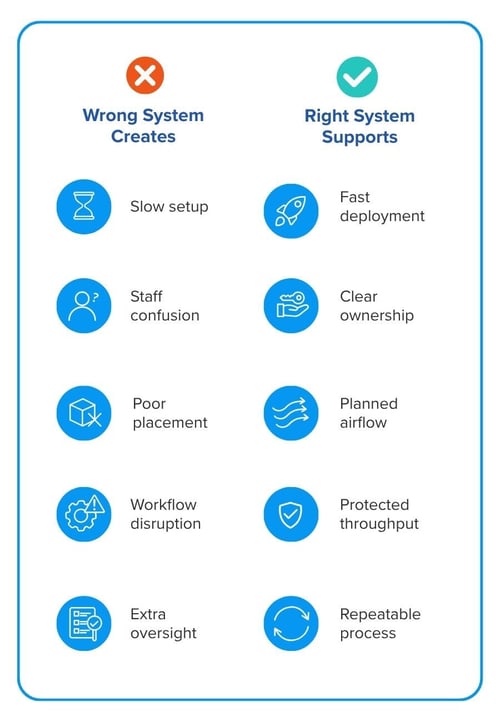 A portable HEPA filtration system should help ASC teams move faster because the process is more controlled, not slower because the equipment is harder to manage.
When Portable HEPA Filtration Can Help Keep OR Schedules Moving
The right filtration setup can support throughput because it reduces the need for improvised decisions during high-pressure work.
Here are the situations where portable HEPA filtration can help protect schedules instead of slowing them down.
During Phased Construction or Renovation
ASCs often cannot shut down an entire facility for upgrades. Work may happen in phases, overnight, over weekends, or around active clinical areas.
Portable HEPA filtration can help support phased construction in active clinical spaces by adding a controlled air-cleaning layer where airborne contaminants are a concern. When used as part of a proper containment and infection control plan, it can help facilities teams avoid last-minute delays caused by uncertainty over dust migration, air movement, or readiness for clinical operations.
The key is planning placement, airflow direction, power access, and monitoring expectations before work begins.
During Maintenance Near Procedure Areas
Not every risk comes from a major renovation. Routine maintenance, ceiling access, HVAC work, plumbing repairs, and small facility upgrades can create dust or airflow concerns.
In these situations, portable air purification gives teams a repeatable response instead of starting from scratch every time. That matters when staff are already stretched and there is limited time between scheduled cases.
If the process is standardized, teams know what to do:
- Assess the work area.
- Confirm the risk level.
- Place containment or filtration equipment.
- Verify airflow and access.
- Complete work.
- Remove equipment without disrupting clinical flow.
That is faster than debating the setup each time.
During Above-Ceiling Work
Above-ceiling work is especially sensitive because it can disturb dust, debris, and particles that are not visible until work begins. In an ASC, this kind of work can quickly create concern if it happens near procedure rooms, sterile processing areas, pre-op, PACU, or clean corridors.
Portable HEPA filtration, used with appropriate containment, can help reduce airborne contaminant concerns and support safer work in active areas. It does not replace planning, but it gives teams a more controlled way to manage temporary disruption.
For related planning context, HEPACART’s article on “What Is an Anteroom?” can support internal education around controlled entry, containment, and adjacent-space protection.
When Equipment Can Slow Down the OR
It is also important to say the quiet part clearly: equipment can slow the OR if it is not selected or implemented well.
Portable HEPA filtration becomes a problem when it creates more work than it removes.
Slow Setup
If equipment requires multiple people, tools, complicated assembly, or repeated troubleshooting, teams may avoid using it until the risk is obvious. By then, the schedule may already be under pressure.
In an ASC, “easy to use” means more than intuitive controls. It means the equipment can be placed, powered, verified, and used without creating a delay that ripples into the case schedule.
Poor Fit for Tight Clinical Spaces
ASC corridors, procedure-adjacent rooms, and support spaces are not designed around construction equipment. A unit that is too large, awkward to move, or difficult to position can interfere with staff movement, carts, supplies, patient transport, or emergency access.
Portable air cleaners and negative air machines need to be evaluated for physical fit, not just filtration specifications.
Unclear Ownership
If no one knows who owns setup, verification, filter checks, movement, and removal, the equipment becomes a coordination problem.
Before adding any portable HEPA filtration system, ASC leaders should define:
- Who determines when it is needed
- Who sets it up
- Who verifies it is operating correctly
- Who monitors it during work
- Who removes it after the project or maintenance task
- Who documents use for compliance purposes
That ownership structure prevents equipment from becoming another unmanaged variable.
Mismatched Performance Expectations
Not every air purifier with a HEPA filter is designed for the same use case. A consumer-style HEPA air purifier is not the same as medical-grade air purifiers or negative air machines designed for healthcare construction, renovation, or infection control support.
This matters because ASC teams may search for “HEPA air purifier,” “air purifier with HEPA filter,” “HEPA air purifier dust,” or “best air purifier for dust” and find products that are not built for active clinical environments.
A true portable HEPA filtration strategy should account for airflow, CFM, room size, air changes per hour, pressure relationships, containment needs, and how the equipment will be used in real facility conditions.
HEPACART’s article on “HEPA vs True HEPA Filter” can be used as an internal education link when teams need help distinguishing meaningful filtration language from weaker product claims.
What ASC Leaders Should Evaluate Before Adding Portable HEPA Filtration
The best way to reduce hesitation is to evaluate the operational risks upfront.
1. Will this support the specific work being done?
A filter unit should match the application.
For example:
- Minor maintenance may require supplemental portable air purification.
- Construction dust may require containment plus HEPA-filtered negative air.
- Above-ceiling work may require localized containment and air control.
- Work near ORs may require a more formal infection control review.
The question is not “Do we need filtration?” The better question is, “What level of air control does this activity require?”
2. How quickly can the system be deployed?
For ASCs, setup time is not a convenience feature. It is a throughput factor.
If containment and filtration can be placed quickly and correctly, work can begin sooner and clinical schedules face less disruption. If setup is slow, unclear, or labor-intensive, the equipment may create the exact delay it is supposed to prevent.
Look for equipment that supports:
- Fast placement
- Minimal tools
- Simple controls
- Clear filter access
- Easy movement between work areas
- Repeatable setup steps
3. Does it support ACH and CFM planning?
ASC teams may not need every staff member to understand detailed ventilation calculations, but the people planning the work should understand how airflow performance is being evaluated.
Air changes per hour, often searched as “ACH calculation,” “air change hour,” or “ACH to CFM,” can help teams think through how much filtered air is being delivered in a given space. CDC ventilation guidance includes air change recommendations for multiple healthcare spaces and notes, for example, specific ventilation requirements for surgery and critical care areas, airborne infection isolation rooms, isolation alcoves, and anterooms.
Portable HEPA filtration should be selected with airflow needs in mind, not just filter type.
4. Will staff actually use it correctly?
This is where many good ideas fail.
If the system is too complicated, staff will work around it. If it is too cumbersome, crews may delay using it. If the process is unclear, Infection Prevention or clinical leadership may lose confidence in the setup.
ASC leaders should look for systems that make correct use the easiest option.
That means:
- Clear setup steps
- Minimal training required
- Durable equipment
- Simple filter change procedures
- Easy-to-understand operational indicators
- Compatibility with facility and contractor workflows
5. Can the system be defended under review?
Infection control decisions need to be defensible.
That does not mean every ASC needs to over-engineer every maintenance task. It does mean leaders should be able to explain why a control was selected, how it was used, and how it supported patient safety and compliance.
The Joint Commission’s preconstruction risk assessment requirement reinforces that construction and renovation work should be assessed for risks that may affect patients, staff, visitors, assets, air quality, infection control, utilities, noise, vibration, and other hazards.
A portable HEPA filtration plan should make that review easier, not harder.
Portable HEPA Filtration vs. Negative Air Machines vs. General Air Purifiers
ASC teams often use these terms interchangeably, but they are not the same operationally.
|
|
|
|
|
|
General HEPA air purifier |
Filters air in a room or area |
Supplemental air cleaning in lower-risk settings |
May not support construction containment or pressure control |
|
Portable HEPA filtration unit |
Provides movable high-efficiency air filtration |
Maintenance, renovation support, temporary air cleaning, dust control |
May be undersized or poorly placed if airflow is not planned |
|
Negative air machine |
Creates negative pressure by exhausting more air than is supplied |
Construction containment, isolation support, dust migration control |
Can disrupt pressure relationships if not set up correctly |
|
Containment plus HEPA filtration |
Combines physical separation with filtered air control |
Active clinical spaces, above-ceiling work, phased construction |
Requires clear setup and monitoring responsibility |
For ASC leaders, the right answer may not be one piece of equipment. It may be a system that combines containment, negative air, portable HEPA filtration, and documented procedures based on the work being performed.
HEPACART’s article on “Benefits of a Medical-Grade Air Purifier” can support readers who are comparing consumer-style air purifiers against equipment intended for healthcare environments.
How to Add Equipment Without Slowing the OR
The safest way to protect throughput is to plan equipment use before the schedule is at risk.
Build Equipment Into the Project Plan Early
Do not wait until the night before work starts to decide what filtration or containment is needed. Include facilities, infection prevention, clinical leadership, construction teams, and vendors early enough to identify placement, access, electrical needs, and staff responsibilities.
Standardize Common Use Cases
Most ASCs have recurring scenarios:
- Ceiling access
- Room refreshes
- HVAC work
- Flooring or wall repairs
- Equipment upgrades
- Small renovation phases
- Emergency maintenance
Create standard response plans for each type of work. This reduces decision fatigue and speeds up implementation.
Use Equipment That Matches ASC Conditions
An ASC is not an empty construction site. Equipment needs to work in active clinical environments with limited space, tight schedules, and minimal tolerance for disruption.
Prioritize:
- Portability
- Fast setup
- Reliable HEPA filtration
- Simple operation
- Compatibility with containment
- Durable construction
- Clear maintenance requirements
Train the Few People Who Need to Own It
Not everyone needs deep technical training. But the responsible team should know how to place, run, check, and remove the equipment.
Training should be short, practical, and tied to real ASC scenarios.
Verify Before Work Starts
The fastest way to avoid delays during the day is to verify the setup before the clinical schedule depends on it.
Confirm:
- Unit placement
- Airflow direction
- Filter status
- Power access
- Noise and access concerns
- Containment integrity
- Documentation expectations
HEPACART’s article on “HEPA Filter Testing: How and When to Test and Replace Your HEPA Filter” can support education around filter maintenance, testing, and replacement expectations.
Common Questions ASC Leaders Ask About Portable HEPA Filtration
Will portable HEPA filtration slow down OR turnover?
It should not slow OR turnover when it is properly planned, correctly placed, and used for the right application. It can create delays if staff are figuring out setup, placement, or ownership during active clinical hours. The goal is to standardize use before it touches the schedule.
Is portable HEPA filtration enough during construction?
Not always. Construction, renovation, and above-ceiling work may require containment, negative air, pressure monitoring, and other infection control measures depending on the risk level. Portable HEPA filtration can be part of the system, but it should not be treated as a standalone answer for every project.
What keywords should this article naturally support?
This article naturally supports searches around portable HEPA filtration, HEPA air purifier, HEPA air filters, medical-grade air purifiers, negative air machine, air purifier with HEPA filter, HEPA air purifier dust, air change hour, ACH calculation, ACH to CFM, infection control, airborne contaminants, portable air purification, and construction dust control.
How should ASCs compare portable HEPA filtration options?
Compare options based on setup time, airflow capacity, HEPA filtration performance, portability, ease of use, durability, maintenance requirements, containment compatibility, and whether the equipment is appropriate for active healthcare or clinical spaces.
Who should be involved in the decision?
Facilities, infection prevention, clinical leadership, construction or maintenance teams, and procurement should all have input. In an ASC, the decision affects patient safety, compliance, workflow, and schedule protection, so it should not be made from a product spec alone.
The Decision Rule: Does This Reduce Variables or Add Them?
For ASC leaders, the best equipment decisions reduce variables.
The right portable HEPA filtration system should make work easier to control. It should give teams a clearer setup, a repeatable process, and more confidence that construction, maintenance, or renovation activity will not interfere with scheduled procedures.
The wrong system adds uncertainty. It creates extra steps, unclear ownership, poor fit, and avoidable friction.
Before choosing a system, ask:
- Does this help us protect patients, staff, and surgical spaces from airborne contaminants?
- Does this support ICRA planning and infection control expectations?
- Can our team deploy it without slowing the schedule?
- Does it fit our physical space and workflow?
- Can it support phased work in active clinical areas?
- Will it reduce the need for last-minute problem solving?
- Can we defend this decision if leadership or compliance teams ask why we chose it?
If the answer is yes, portable HEPA filtration is not a slowdown. It is part of keeping the OR schedule protected while necessary work continues.
Keep the OR Moving With Air Control You Can Plan Around
ASC leaders are right to question anything that could slow down the OR. Throughput is too important, and the margin for error is too small.
But avoiding equipment is not the same as avoiding disruption. In many cases, the bigger risk comes from relying on improvised containment, unclear air control, or last-minute decision-making when construction or maintenance work is already underway.
The right portable HEPA filtration system gives ASC teams a more controlled way to support air quality, manage dust and airborne contaminants, and keep projects moving inside active clinical spaces. It does not replace infection control planning, but it can make that planning easier to execute.
For ASCs, the standard should be clear: add equipment only when it reduces risk, supports compliance, and helps the team keep scheduled procedures moving. That starts with understanding the airflow requirements for the space you’re trying to protect.
Before your next project, maintenance task, or renovation phase begins, use HEPACART’s Air Changes Calculator to estimate the air changes per hour needed for your room or work area. It’s a practical first step for planning portable HEPA filtration, negative air, and containment strategies around real facility conditions instead of guesswork.

Share this
