
Share this
by HEPACART on Dec 15, 2025
.png?width=900&height=450&name=Blog_SchoolSetting_900x450%20(1).png)
Indoor air quality (IAQ) in schools is constantly changing. From crowded hallways and full classrooms to seasonal shifts and construction projects, the air students breathe rarely stays consistent. Yet many schools only take action when issues become impossible to ignore when allergy complaints spike, illness spreads, or a failed inspection forces a response.
The problem is that standard school HVAC systems weren’t built to handle continuous, real-time abatement of airborne contaminants. Without a clear process to assess, improve, and repeat, facility managers risk falling behind on compliance and falling short on keeping students and staff healthy.
Step 1: Assess the Current State of Indoor Air
You can’t fix what you can’t see. Particularly in classrooms where the consequences can wreak havoc on students’ learning and overall health, it’s critically important that you know what to look out for as warning signs of poor air quality.
8 Warning Signs of Poor School Air Quality
- Stuffy, stagnant rooms, even when the HVAC is running
- Recurring allergy or asthma flare-ups among students or staff
- Odors that linger or worsen throughout the day
- Visible dust or buildup around vents and ceiling tiles
- Condensation or moisture on windows or walls, signaling humidity issues
- Frequent headaches or fatigue complaints from occupants
- Mold or mildew growth in restrooms, locker rooms, or storage areas
- Uneven airflow or temperature differences between classrooms or offices
If you’re noticing 3 or more of these symptoms, your facility may be at risk of poor air quality.
These symptoms often point to a buildup of carbon dioxide (CO₂), fine particles (PM2.5), or volatile organic compounds (VOCs). EPA’s Tools for Schools program identifies all of these as major contributors to poor air quality.
Implement Consistent Air Quality Monitoring
In order to stay on top of potential threats, consider investing in real-time monitoring tools. Portable sensors can measure these particles in your school’s air and give you and your team real data that can guide your next steps. Whether that means maintenance, renovation, or overhauling your air quality equipment, you can make those decisions with confidence if you know what’s actually going on.
Most importantly, assessment should never be a one-time event. Occupancy, building use, and weather patterns all shift over time, and so should your understanding of how air moves through your school. A quarterly or seasonal IAQ check ensures you’re spotting small issues before they grow.
Step 2: Improve With Effective Abatement Technologies
Once you’ve identified where air quality is slipping, it’s time to strengthen your abatement strategy. The goal isn’t just to fix isolated issues. It’s to create a system that continuously captures, contains, and filters airborne contaminants throughout your school.
Go Beyond HVAC Upgrades
HVAC systems move air, but they don’t manage contaminants. That’s why more schools are turning to abatement technologies. These purpose-built solutions tackle dust, spores, and pathogens head-on.
In most facilities, that includes:
- Hospital-grade HEPA air purifiers that capture 99.97% of airborne particles ≥0.3 microns, including dust, pollen, bacteria, and some viruses.
- Negative air machines that create containment zones during construction, renovation, or maintenance to keep dust, spores, and debris from spreading to occupied areas.
- Mobile air scrubbers that deliver flexible, high-volume filtration in gyms, cafeterias, classrooms, and nurses’ offices where foot traffic and exposure risks are higher.
These tools work in tandem with your existing systems and give you the control and flexibility that standard HVAC alone can’t provide.
Meet The HEPACART® GermBuster™
When you need hospital-grade air quality in a school setting, the HEPACART GermBuster delivers. Built for continuous use, this portable HEPA filtration unit quietly removes airborne contaminants without interrupting class or conversation.
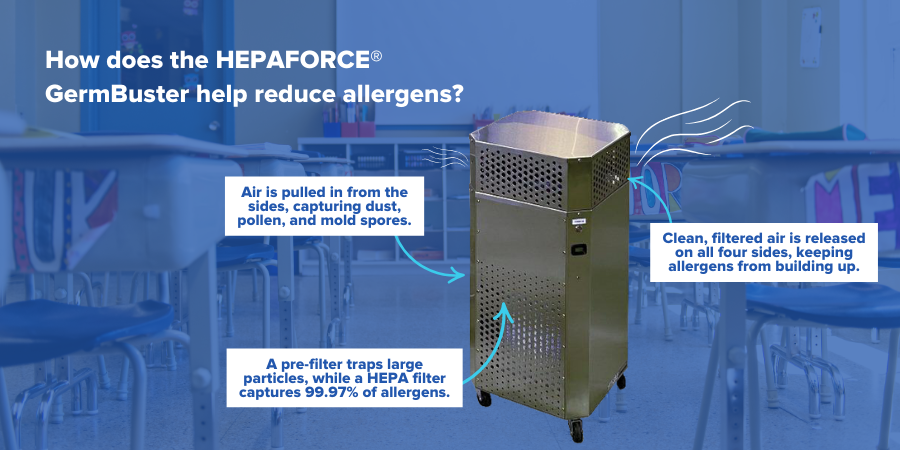
The GermBuster is engineered for the realities of education facilities. It’s durable enough for daily use, quiet enough for classrooms, and 40% more energy-efficient than comparable units. And with flexible subscription options, schools can easily scale protection where and when it’s needed most.
Unlike small consumer purifiers, the GermBuster works alongside your existing HVAC system to continuously capture and recirculate clean air. For facility managers aiming to meet EPA and ASHRAE 241 standards, it’s a reliable, proven way to move from basic filtration to consistent, compliant protection.
Step 3: Repeat a Manageable IAQ Process
Good air quality isn’t something you set and forget. It’s a process you build and stick to. The most effective facilities don’t wait for a complaint or inspection to check their air. They follow a consistent rhythm of monitoring, maintenance, and adjustment throughout the year.
Every school’s environment changes with the seasons, and your air management strategy should change with it.
Seasonal IAQ Dangers to Consider
Winter: Closed windows, full classrooms, and more time indoors mean higher CO₂ levels and greater risk of virus transmission.
Spring: Pollen and humidity climb, and filters start working overtime.
Summer: Renovation and maintenance projects kick up dust, debris, and everything you don’t want in your air.
Fall: As students return to school, occupancy spikes overnight and ventilation systems get their first real test of the year, exactly when air quality needs the most attention.
A strong IAQ program accounts for all of it. By turning air quality management into a repeatable process, your team can move from reacting to problems to preventing them.
A Simple Plan Supports Your Facility
A clear, repeatable plan makes air quality management easier to sustain and easier to prove. When your team knows exactly what to do each season, IAQ stays steady, and surprises stay minimal.
Here’s what that looks like in practice:
- Stay on schedule with seasonal reassessments, filter changes, and performance checks.
- Reallocate portable filtration, like the GermBuster, to high-traffic or high-risk areas during peak seasons.
- Document IAQ readings and inspection results to simplify compliance reporting and show measurable progress.
When this cycle becomes part of your normal maintenance routine, you stop firefighting and start managing. The payoff is consistent, reliable air quality year-round, meaning healthier students, fewer disruptions, and full confidence your facility meets EPA and ASHRAE 241 standards.
The ROI of a Proactive Approach

When schools stop reacting to air quality problems and start managing them, everything runs more smoothly. Cleaner air means healthier students, fewer absences, and better focus in the classroom.
A proactive plan also saves money. Durable HEPA systems like the GermBuster cut down on emergency fixes and extend equipment life, while regular monitoring keeps maintenance predictable.
And people notice. Teachers breathe easier, rooms stay fresher, and complaints go down. Treat air quality like any other critical system rather than a crisis to fix. When you’re acting proactively, everyone benefits, from your maintenance team to the students in every seat.
Healthier Air, Healthier Schools
Clean air doesn’t happen by chance. It happens by process. Schools that commit to a steady rhythm of assess, improve, repeat stay ahead of problems instead of reacting to them.
When durable, high-efficiency tools like the HEPACART GermBuster become part of your regular maintenance plan, compliance gets easier, equipment lasts longer, and the air stays cleaner year-round. The result is what every facility manager wants: healthier students, fewer complaints, and classrooms that simply work better.
Ready to put a plan in place? Download the Ultimate Guide to Indoor Air Quality and start building a long-term strategy that keeps your facility one step ahead.

Share this
